
Lives of Rubble
Published on: January 5th, 2026
Read time: 12 mins
Dressed all in black, Fátima was washing the dishes outside the site cabin that had been her home for the last three years. In her late seventies and widowed for a decade, she moved into this temporary dwelling after her previous house was demolished during a police drug raid on a nearby plot in the settlement. It didn’t matter to the council’s urban discipline officials, who arrived the following day, that no drugs had been found in Fátima’s house, or that she had nowhere else to go if they demolished it. So, she had to move, again, and improvise a solution. After spending a few weeks at one of her daughters’ site cabins, she managed to get one for herself next to theirs, on a piece of land where the remains of tiled floors and foundations evoked more settled times: traces of a better-off past coalescing in the surviving tiles and in the piles of rubble pushed to the back of the plot as an improvised fence.
Fátima invited me into the cabin to talk ‘more calmly,’ as the petrol generators filled the air with their noise, a noise I only realised was so oppressive once I stepped inside and stopped hearing it. Two years have passed since the electricity company cut off power to the settlement. Fátima told me that, at the time, they didn’t have the money to invest in solar panels, a more expensive option in the short term, but more efficient in the long run: “Back then, we didn’t think about it, and now we don’t have the money. We can’t save either; these engines eat up every euro we have.” I empathised with her. I hadn’t expected that blackout, which by no means was the first in the settlement, to become the definitive one.
We began talking about her life in the settlement, and she told me a story I’ve heard many times from different people, with variations, but always following the same arc. Married to Manuel in their teenage years, they lived in the small village where they had grown up and met. There, they started their family, and eight of their eleven children were born. Manuel made a living as a seasonal agricultural worker, mainly in the olive harvest and in olive oil production at the local press. Fátima took care of the household and contributed to the family economy with goods she received from the charity of her female neighbours, women she met while doing laundry by the river or in other women’s spaces.
Fátima recalled a life of hard work, earning just enough to pay the rent on the adobe house they lived in and to feed the family. At some point, “we weren’t earning enough from the fields for so many people,” she said, so they moved to the capital in the late 1970s, like so many other families seeking a better future. For several years, Fátima told me, they never really settled. They moved from one place to another, building shacks out of waste materials until the police tore them down, and then they would move again. Their main means of earning a living was their van, which they used to collect scrap or sell fruit as street vendors, anything that helped them make ends meet.
They kept that nomadic habit, a completely new experience for them, as their families had been settled in the same region for generations, until they were given one of the prefabricated houses in the special typology neighbourhood in the then south outskirts of the city. In her own words, those prefabricated homes were “wonderful, they had everything a house should have.” But they were not relocated when the area became part of a new urban development project and the evictions came: “They threw us out, they cheated us, and they didn’t give us a thing. Some people got houses; they told us we would get one, but they gave us nothing.”
“So we moved to the settlement,” she continued. “There were a lot of payos living here then, with their allotments and orchards, oh!, the women had beautiful gardens here, but they didn’t want to stay anymore. They started selling, and we bought a small piece of land and settled here.” Twenty years later, she was still there, but the house they built was now in ruins, and the land they had bought was no longer usable. She had to move in with one of her daughters, who had also been unable to leave the settlement. Together, we reminisced about the gradual deterioration of the settlement (and consequently, her living conditions) in recent years, which culminated in the power outage in October 2020. This was not restored during the snowstorm that left the area in the grip of freezing temperatures. “They are slowly killing us,” said Fátima. “Who can live without electricity like this?”
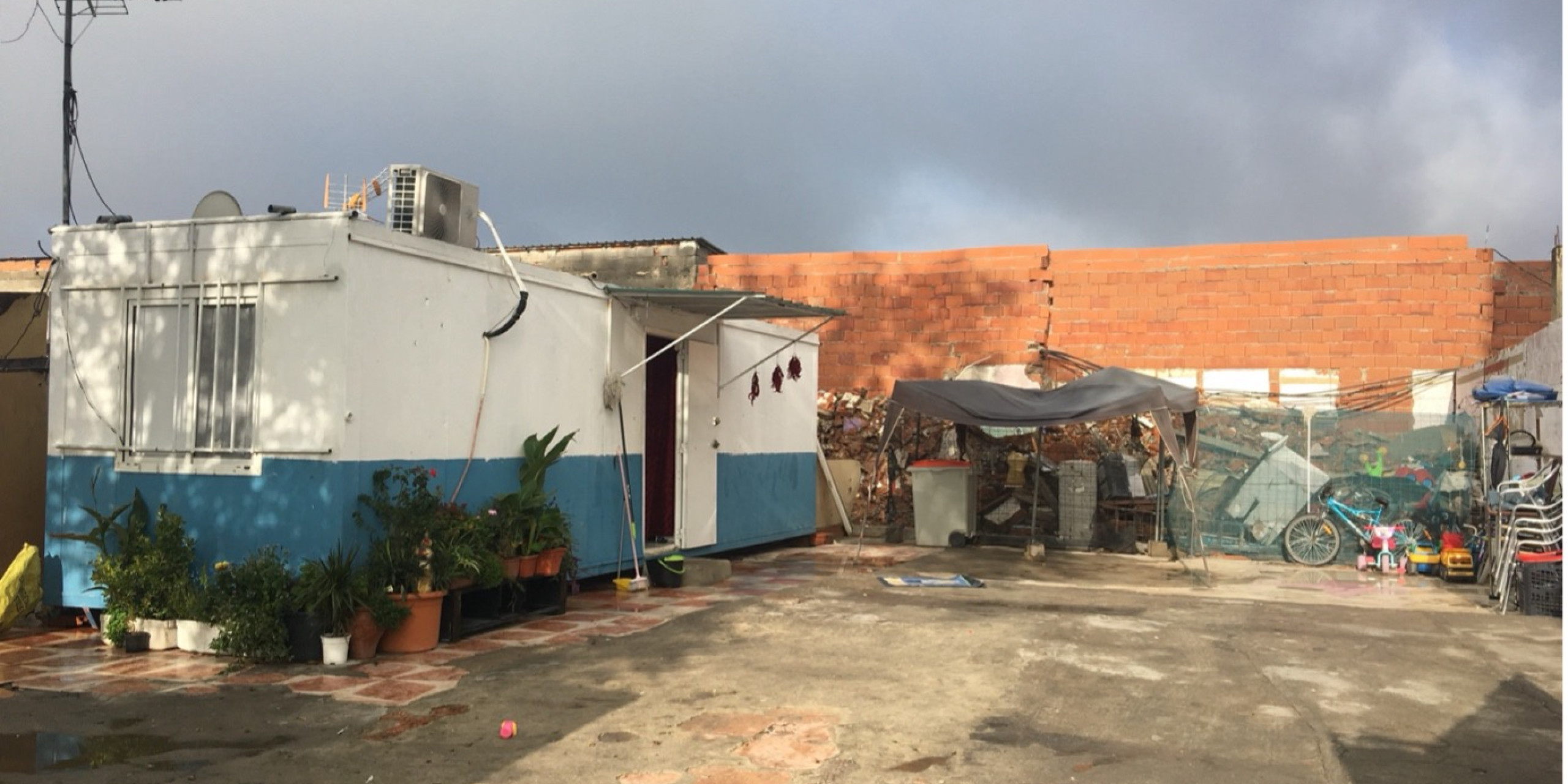
Photo via author
This is a concise account of the life of a Spanish Romani woman (Gitana) living in an informal settlement on the outskirts of Madrid. When rewriting my fieldnotes for this paper, I deliberately omitted the references to ethnicity and location until the final quotation from Fátima, in which she uses the term ‘payos’ to refer to non-Roma. My aim was to draw the reader’s attention to the many other locales and populations that endure conditions as dire as those experienced by Roma communities. “They are slowly killing us”, Fátima told me, evoking the concept of “slow death” as defined by Laurent Berlant Berlant LG. Cruel Optimism. Durham: Duke University Press; 2011. 1 p. , after enduring two years without electricity, just one symptom of the ongoing deterioration of living conditions in Cañada Real. Since 2007, I have worked in Cañada as a physician witnessing this progressive decline even as the number of programmes ostensibly designed to “integrate” Romani communities has multiplied. For over fifteen years, I have occupied the ambivalent role of representing an institution of both care and control, continually trying to align myself with the interests of the people of Cañada Real. It is from this position that I conduct my academic research, intending to contribute to the dismantling of some of the negative stereotypes that remain so detrimental to Romani populations in Spain. The diverse Romani populations of Cañada Real (who have varied origins, beliefs and livelihoods) provides a productive entry point for understanding the wider patterns of marginalisation experienced by Romanies across the country, and the insidious forms of neoliberal biopower that, in the words of Eric Fassin “may not make them die, but they won't let them live” Fassin É, Fouteau C, Guichard S, Windels A. Roms & riverains: une politique municipale de la race. Paris: La Fabrique éditions; 2014. 227 p. .
Fátima’s life story, in its various dimensions, represents a common life trajectory that so many Gitanos (Spanish Roma) I use the word gitano/a when referring to Romani people who have been settled in Spain for centuries, as it is a term they use to refer to themselves. Although gitano can be used as an offensive adjective in Spanish, it has fewer pejorative connotations than the term 'gypsy' in other languages. I use the term 'Romani communities' to refer to both 'Gitano' and migrant Roma. in Spain have followed. Despite a brief impasse before the 2008 economic recession, when Spain was considered a model for Romani inclusion, the Gitanos in Spain are the most disadvantaged population, with half of them living in extreme social exclusion. I have focused on Fátima’s housing situation to illustrate how phenomena that are typically understood and explained in cultural terms, or as idiosyncratic of Gitano populations, are shaped by differential trajectories and specific housing policies aimed at Gitano populations. These policies are often informed by antigypsism, both in the way they are devised and implemented.
Let’s start at the end: Cañada Real is an informal settlement where Fátima has lived with her family for the past twenty years. Portrayed in the media as the biggest slum in Europe, Cañada evolved from a cattle path and vegetable garden to a road for trash trucks to Madrid’s dumpsite and a place of arrival for those with nowhere else to go. Gonick S. Interrogating Madrid’s “Slum of Shame”: Urban Expansion, Race, and Place-Based Activisms in the Cañada Real Galiana. Antipode. 2015;47(5):1224–42. Romanies and North African migrants make up the largest populations. Since 2000, its population has doubled, and it has gained notoriety as a place of conflict, drug dealing and evictions. Power outages and the refusal of regional authorities to intervene were based on claims that electricity was being used to power cannabis farms. Fátima, too, ended up there when she had nowhere else to go. This was during the construction industry boom of the early 2000s, when the outskirts were transformed into new neighbourhoods. Those living there, in either formal or informal settlements, were evicted. At that time, Fátima was living with her family in a ‘special typology neighbourhood’, a product of policies from the 1980s and 1990s that aimed to eradicate the slums and their association with Madrid’s backward past. These ghetto-like estates were purposefully built by the council agencies in charge of the eradication-relocation programmes to accommodate what, in their view, were the Gitano’s differences, and they were the sole inhabitants.
The agencies framed these isolating housing policies as inclusive and positive discrimination measures for Gitanos, as they were a means of dealing with a population that had not yet embraced “European modernity”. In the agencies’ logic, isolating Gitanos allowed them to learn how to integrate into modern society while maintaining their traditional way of life. These policies are underpinned by an ambivalent logic that presents inclusion as only possible through exclusion. To foster the participation of Gitanos in society, they must be isolated. Gay y Blasco P. ‘It’s the best place for them’: normalising Roma segregation in Madrid. Social Anthropology. 2016 Nov 1;24(4):446–61. This exclusionary logic has shaped many of the programmes designed to promote the inclusion of Gitanos in Spain and elsewhere. Picker G. Racial cities: governance and the segregation of Romani people in urban Europe. London ; New York: Routledge, Taylor & Francis Group; 2017. 173 p. (Routledge advances in sociology). As the city continued to grow, more slums were to be eradicated, and even the isolated special typologies neighbourhoods were in the way of the new urban developments of the 2000s and were to be eradicated too. When their neighbourhood was demolished, Fátima’s family was not offered alternative housing, so they moved to Cañada, which seemed far from the authorities’ demolition projects. At the time, Cañada was not targeted by eradication programmes, nor was it on the political agenda or in urban planning documents. For council agencies, Cañada was a convenient solution as it provided a place for people who were not offered alternative housing to go. They turned a blind eye to it and Cañada became home to families displaced by the eradication-relocation programmes.
Evictions arrived in Cañada sooner than Fátima expected, this time disguised as a public health measure. Since 2013, when the European High Court of Human Rights ruled against demolitions based on urban infractions, demolitions in Cañada after drug raids have become the main institutional mechanism to evict people. In Fátima’s case, the police issued a demolition order after the raid based on the premise that the houses were instrumental in committing a public health offence (drug dealing). The order was issued for all the houses on the plot, even though they did not find any drugs in several of the houses, including Fátima’s. The institutional response to drug dealing targeted not just the offenders, but their entire families. In other contexts, the practice of demolishing entire homes and evicting people who are not involved in the offence would be inconceivable; no one would dare destroy an entire block of flats due to one apartment’s involvement in drug dealing, thereby rendering other neighbours homeless. The social organisation of the Gitanos in extended families, when connected with drug dealing, is perversely used as an aggravating factor for the offence. It becomes an institutional means of infrastructural violence against Romani populations.
In conclusion, I aimed to illustrate through Fátima’s life story how the various forms of anti-Gypsyism shape the life trajectories of Romani communities in Spain. Infrastructural violence Rodgers D, O’Neill B. Introduction: Infrastructural violence: Introduction to the special issue. Ethnography. 2012;13(4):401–12. dominates the lives of the Romani people in Cañada, trapping them within a racialised time of chronic crisis Vigh H. Crisis and Chronicity: Anthropological Perspectives on Continuous Conflict and Decline. Ethnos. 2008 Mar 1;73(1):5–24. . This often occurs across multiple generations and leaves them on the margins of citizenship. These forms of violence, which sometimes take the form of neglect, are met with different and creative forms of resistance, but they take their toll on people’s lives. Relying on family ties to cope with housing insecurity is one of the strategies of resistance that paradoxically exposed them to insecurity, as shown in Fátima’s case. However, it also shapes community and support networks in the face of a hostile world.
Fátima’s story thus stands as a reminder that what is too often framed as cultural difference is, in fact, the cumulative effect of antigypsyism that is embedded in the everyday infrastructures of life, and why confronting these structural conditions is essential if Romani futures in Spain are to be imagined beyond mere survival.
Featured photo used with permissions from Boa Mistura. All rights are reserved.
Bulletin posts represent the views of the author(s) and not those of the ISRF.
Unless stated otherwise, all posts are licensed under a Creative Commons Attribution- NoDerivatives 4.0 International License.