
Grateful Harbours: Oil, Gratitude and Transition in Aberdeen and St. John’s
by Anya Kuteleva and Justin Leifso
Published on: November 17th, 2026
Read time: 9 mins
One Company, Two Harbours
In early October 2026, Ithaca Energy, an oil and gas producer headquartered in Aberdeen, agreed to buy Suncor’s stakes in the Terra Nova and White Rose fields off Newfoundland. It was the company's first acquisition outside the North Sea. Two weeks later, its executive chair, Yaniv Friedman, told the Financial Times (FT) that Ithaca would probably stop investing in Britain if the government rejected the Rosebank oilfield west of Shetland. Its UK projects, he said, were now competing with opportunities in Canada. Having more options on the menu that can compete for capital, he added, was a good choice to have. Friedman noted that the Canadian deal had been planned for several years, regardless of UK energy policy, but said it would give Ithaca greater choice over where to invest.
We are less interested in the company's strategy and rather choose to focus on how each city received it. In St. John’s, Newfoundland, a new operator arrived as good news. In Aberdeen, Scotland, an investor who might leave was framed as a warning about what the country stood to lose. In the same month, the same firm was a welcome newcomer in one harbour and a benefactor threatening to walk away from the other.
We have been studying how these two cities live with oil while the UK and Canada promise to move beyond it. Both are mature offshore oil capitals in countries that are not usually considered petrostates. October's news brought into focus a recurring finding from our fieldwork: people in both places feel grateful to the oil industry.
A Feeling with a History
Gratitude is not the first emotion that comes to mind in debates about fossil fuels. Discussions of the energy transition usually turn on interests: jobs, revenues, profits. Or they turn on information. If people only understood the climate science, the reasoning goes, their attachment to oil would lessen.
Gratitude works differently. It is a sense of having been provided for, and of owing something in return. In both cities it has a long history. Oil came ashore in Aberdeen in the 1970s. In Newfoundland it arrived in the 1990s, just a few years after the 1992 cod moratorium closed the fishery that had defined the province for centuries. Over decades, oil sustained wages, public services, and civic life. As one long-time St. John's resident told us, “The strongest cultural story is that oil enables young people to come home.” In both cities, locals pointed to what oil money had paid for: houses, cars, restaurants, children’s university fees. In Aberdeen, more than one person reached for the same proverb when the conversation turned to oil’s critics: “Don’t bite the hand that feeds you.” This gratitude sits alongside pride, fear, and resentment and persists even as fewer households depend on oil. While anger and grievances fall on companies and governments for disasters, layoffs, and broken promises, residents still feel gratitude towards the industry as a whole.

Port in Aberdeen. Photo provided by authors.
This history shapes how we read the politics. This gratitude was not manufactured by oil companies or governments. It is not false consciousness or merely a product of clever public relations. It was produced collectively, over decades, in families, workplaces and communities. It is then preserved through interpretive infrastructures, such as museums, memorials, science centres, industry-sponsored events, and the names of public institutions, which keep retelling the story of provision long after the boom. Because it endures, those with a stake in keeping oil flowing, from companies and industry bodies to governments, can draw on it.
On the Waterfront
Walk along the harbour in either city and you will see offshore supply vessels, the working boats that carry equipment, fuel, and provisions to installations far out at sea. In St. John’s, they berth along the working wharves of the inner harbour, where quayside storage areas, containers, and heavy equipment line the water, with the steep, built-up waterfront rising behind them. They share the harbour with crab boats that head offshore for days at a time into the cold North Atlantic.
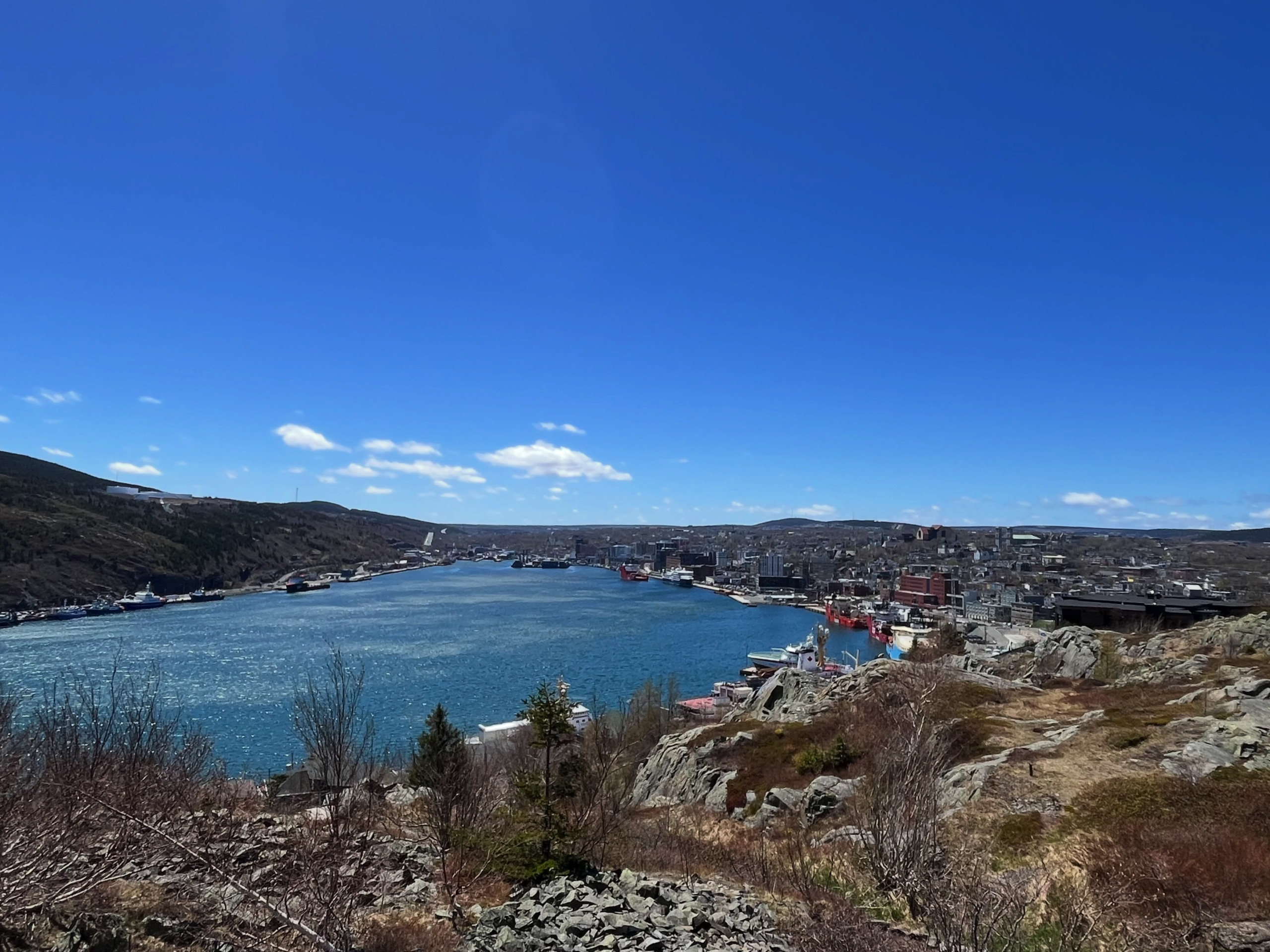
St. John's harbour. Photo provided by authors.
In Aberdeen, the same kind of vessel raises a question that cannot be answered from the quay: is it servicing an oil platform or an offshore wind farm? The port now handles around 600 offshore wind vessels a year, yet wind brings in about one per cent of its revenue, while oil and gas still account for roughly two thirds. The oil itself is nowhere to be seen. Still, you know it is there. Helicopters lift off from the airport at Dyce for installations far offshore. Company names line the office parks on the edge of the city, and the industry fills the pages of the local press. As one of the industry veterans we talked to describes it, “If in a street of ten houses, every other one used to have someone working in the industry, now perhaps every fourth house does.” Although the industry is shrinking, much of what surrounds you exists because of oil, even when oil itself stays out of sight.
Gratitude depends, in part, on this invisibility: oil is less an industry the city looks at than a condition it stands on.
Rebranding Gratitude
Museums are where cities tell themselves who they are, so we spent time in them: Aberdeen Maritime Museum and Aberdeen Art Gallery in Scotland, and The Rooms and the GeoCentre in St. John’s.
One panel at the GeoCentre, titled “Oil + Gas in the Bigger Picture”, sums up the relationship. Oil, it tells visitors, brought new, well-paid jobs and changed “how we live, what we do, and what we can do”. It does not hide the risks: prices and production depend on events far beyond the province. Yet the lesson it offers is that benefiting from oil also requires adapting to change and riding out the ups and downs. Volatility is presented not as a reason to question the relationship, but as part of what one accepts in return for it. At The Rooms, the provincial museum, oil and extraction barely appear in the displays, yet plaques remind visitors that oil companies sponsor the institution. Similarly, Aberdeen Art Gallery and the Maritime Museum draw on the industry’s donations and gifts. The gallery’s new exhibition includes a painting of the pipeline route, commissioned by British Petroleum (BP) in the 1990s for its exploration control room at Dyce. Much of the Maritime Museum’s oil collection was donated by oil companies, often prototypes and obsolete equipment, and its central oil display dates from the late 1990s.
Such donations, however, are now slowing because, as one curator in Aberdeen explained, companies are wary of accusations of greenwashing. Where they still give, they increasingly fund initiatives that promote the energy transition rather than celebrate themselves. According to another representative of an Aberdeen institution, “Even the staunchest oil and gas companies are seeing that the future is renewable energy.” Meanwhile, museums and science centres relabel collections once described as “oil and gas” as the “energy industry” and tell the story of a transition already under way. That story carries a promise about the future, in which climate-conscious oil companies become the force pushing the transition forward.
Antonio Gramsci called this kind of manoeuvre trasformismo: absorbing a challenge by taking on its language, so that change happens on the incumbent’s terms. Renaming is one of its clearest signs and runs across interpretive infrastructures, from regulators to museum collections. In 2022, the UK’s Oil and Gas Authority became the North Sea Transition Authority. In June 2025, the Canada-Newfoundland and Labrador Offshore Petroleum Board became the Canada-Newfoundland and Labrador Offshore Energy Regulator, with a mandate extended to offshore renewables.
The new names and institutional changes not only promise transition but also carry the gratitude accumulated over decades of extraction into a future whose terms remain unsettled.
October, In Their Own Words
The response to October’s news shows how gratitude becomes available for use. On 21 October the UK government approved the Jackdaw gas field east of Aberdeen. Charandeep Singh, chief executive of the Scottish Chambers of Commerce, said the decision would be “felt in workshops, yards and engineering firms right across the country”. He called it proof that the skills and industrial base built up in the North Sea are still valued and pressed for Rosebank to follow. The language is one of provision: the industry as the source of livelihoods well beyond the oil capital itself.
In St. John’s, Jim Keating, head of the province’s Crown oil and gas corporation (OilCo), called Ithaca's purchase “a vote of confidence for our offshore”. Days later, Premier Tony Wakeham was anticipating a windfall from oil prices driven up by the war in Iran. He promised to grow the offshore industry and use the proceeds to build “something that lasts”.
In Newfoundland, investment arrives as recognition: someone has chosen us. In Scotland, investment that might leave is presented as a loss the public risks bringing on itself. Friedman's menu of options makes the underlying logic plain. Capital can move between harbours. Gratitude cannot: it was built up over decades in each city and stays there, whether or not the company does.
Why Gratitude Matters for Transition
Debates about transition often assume that the problem is information. Many of oil critics believe that people would lessen their attachment to oil if they better understood the climate risks. Industry offers the mirror image: Friedman told the FT that Cambo, another Ithaca field, is “a critical project for the UK and I'm not sure the public fully understands this.”
In contrast, we found that people in both cities were well aware of oil’s environmental, economic, and human risks. Both cities have lived through disasters and downturns. The problem was not a lack of information.
What sustains consent is something else. Gratitude makes it feel ungracious to question the industry that provided for you, and it makes calls to wind it down sound like disloyalty rather than prudence.
Transition policies that speak only the language of jobs and emissions miss this. A transition that hopes to win consent in places like Aberdeen and St. John’s will have to take gratitude seriously rather than dismiss it. Above all, it will have to give people something new to be grateful for.
Feature image by Erik Mclean on Unsplash.
Blog posts represent the views of the author(s) and not those of the ISRF.
Unless stated otherwise, all posts are licensed under a Creative Commons Attribution - NoDerivatives 4.0 International License.